Episode Transcript
[00:00:00] Speaker A: But as you know, I almost wrote a book back in what 2013, 2016, called the ultimate human delusion, but I never really went forward with it because I just didn't know what was missing. Now I realize I needed to take a detour into yoga.
[00:00:15] Speaker B: Yeah.
[00:00:15] Speaker A: Because using the chakra system to explain ourselves and teams and couples and organizations and societies and cultures, we're accumulation of all of those, you know, water molecules.
[00:00:27] Speaker B: Yeah.
[00:00:28] Speaker A: So for sure, how much of that makeup is hornified.
[00:00:30] Speaker B: Yeah.
[00:00:32] Speaker C: Right.
[00:00:32] Speaker A: That's kind of what this is all about.
[00:00:33] Speaker B: Yeah.
[00:00:34] Speaker D: This episode of Roots to Fruits is produced and distributed by Be Connected, a social media management firm in Northeast Wisconsin.
[00:00:51] Speaker C: Hey, everyone, I'm Kelly Williams, and welcome to the Roots to fruits podcast.
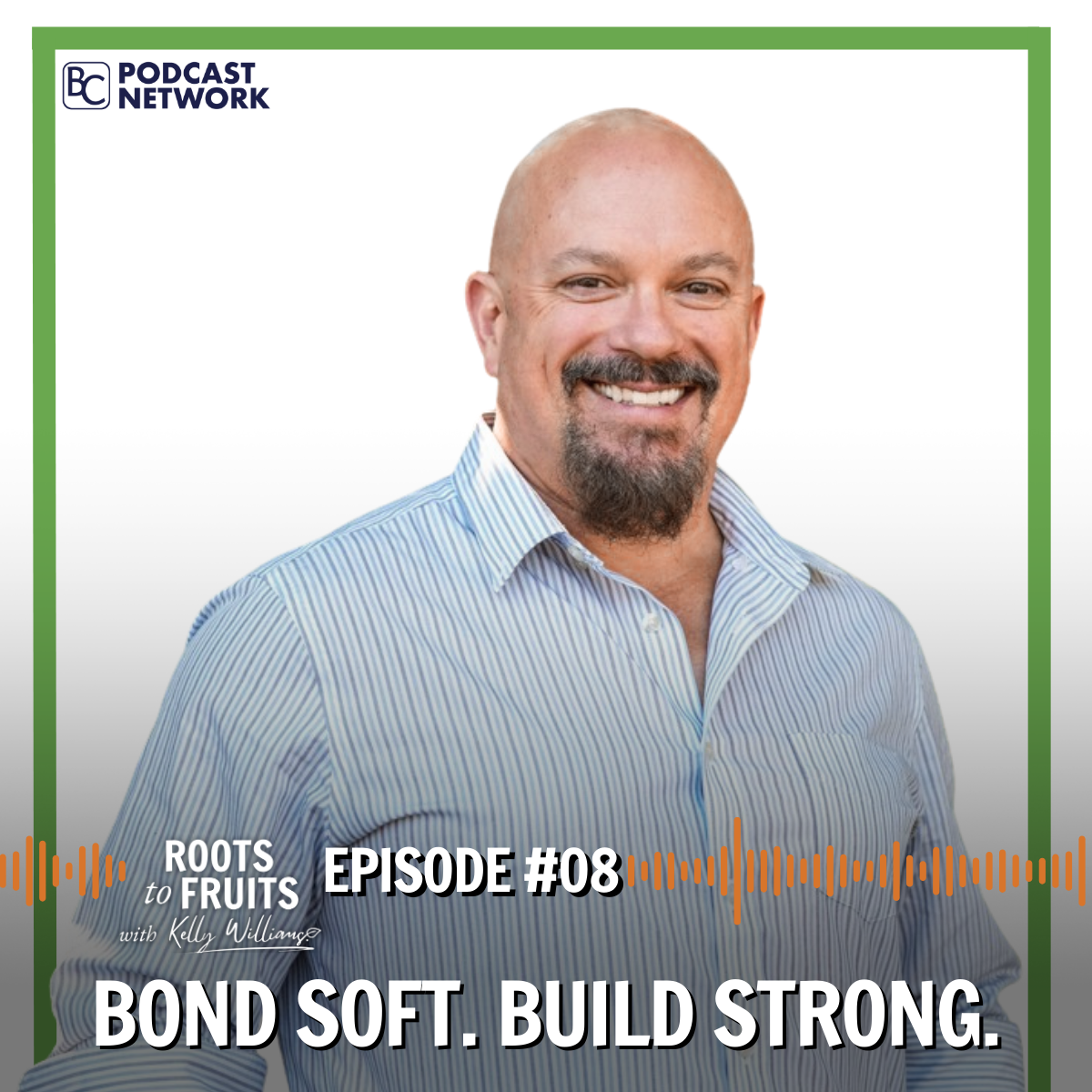
Episode 10 is a little different and honestly, a little unexpected.
A while back, before Tiny Hands was even out in the world, I sat down with a longtime colleague and friend, Rick Stokes.
Rick and I have spent decades in the same industry, learning, building, and honestly trying to make sense of a lot of the same challenges, from leadership to innovation, to what it really means to connect its people at the same time. This wasn't meant to be a podcast. It was just a conversation.
Two people reflecting on ideas from the book, where they came from, and how they show up in real life.
But as we listened back, it felt too real and too meaningful not to share.
So what you're about to hear is that conversation.
Raw, unscripted, and very much in the moment.
We talk about everything from leadership and empathy to science systems and what it means to truly belong.
Some of the core ideas behind Tiny Hands.
And Rick brings a perspective that I deeply respect.
He's someone I've always considered an enzymatic leader, someone who creates space for others to grow and do their best work.
As we close out season one of Roots to Fruits, I just want to say thank you for being part of this journey.
We've got an exciting second season coming with some incredible guests ahead.
So with that, I hope you enjoy this conversation as much as we did having it.
Here's Rick Stokes, and as always, build soft bond strong.
[00:02:43] Speaker A: So, Rick, you finally read the book?
[00:02:46] Speaker B: Finally. Yeah. Yeah. Thanks for the advanced copy. Yeah.
You can tell it's been well traveled.
[00:02:54] Speaker A: Better traveled than if I were with it.
[00:02:57] Speaker B: That's great.
That's good.
[00:02:59] Speaker A: So what do you think?
[00:03:00] Speaker B: That was outstanding. Outstanding. I think one knowing you really got you out of there and into the book, which I love. Right.
So it's just great to have it documented. As you know, I've bought copies for all my team. You Know, I want them to read it because we've kind of grown up in this industry together. Right. So a lot of what's in you is also in me. And I think it's really going to help explain to my team, you know, some of the areas that I come from and some of the things that I'm trying to project. So. So, yeah, man, thanks for. Thanks for writing it all down and
[00:03:33] Speaker A: being an engineer yourself.
[00:03:34] Speaker B: Engineer as well.
[00:03:35] Speaker A: It definitely, I think, appeals to the technical person, but I think also so reduced to. Anybody can.
[00:03:42] Speaker B: Yeah. Can.
[00:03:43] Speaker A: Can get it.
[00:03:43] Speaker B: Well, I think, you know, engineers are stereotypically not in touch.
Right, right. I think you and I are trying to, you know, break that.
Break that reputation a little bit and, you know, do be in touch and do be approachable and do be, you know, sensitive to the human condition and things like that. So. So, yeah, we're. We're breaking the stereotype a little bit.
But it's a good thing. It's a good thing. Right. And to be able to kind of write that down and define it and define how we're doing it is really cool.
[00:04:11] Speaker A: And where. It didn't start as a book.
[00:04:14] Speaker B: Yeah.
[00:04:14] Speaker A: And it started as a white paper, which led to another white paper, which led to another white paper to remember. It's like, I think this might actually be a book. But it was really just realizing that water represents everything. So if you look at what a water molecule does and, you know, on the book, that's oxygen and two hands, the hydrogen, tiny hydrogen hands holding a DNA molecule. Because that is what holds a DNA molecule together. It holds everything together. That's what allows water to rise up a tree against gravity, is hydrogen bonding.
[00:04:48] Speaker B: Yeah.
[00:04:48] Speaker A: And what's so great about hydrogen bonding is it's a super weak force. It's barely touching.
[00:04:52] Speaker B: Yeah.
[00:04:53] Speaker A: But in large numbers.
[00:04:54] Speaker B: Yeah. Probably the most important force on the planet, if not the universe. Right. For life.
[00:04:58] Speaker A: For life. Because you can't do without it.
[00:05:01] Speaker B: Yeah.
[00:05:02] Speaker A: And then, you know, that kind of led to realizing that people are just like a water molecule.
[00:05:06] Speaker B: Yeah.
[00:05:08] Speaker A: And so all the metaphors started to become. Not just metaphors, scientifically founded.
And so I just felt the need to. To explain it. And then so much of it came from that purposeful pursuit to put it together.
These other pieces, like realizing that you see that in leadership.
[00:05:27] Speaker B: Yeah.
[00:05:27] Speaker A: With what I call an enzymatic leader.
[00:05:29] Speaker B: Right.
[00:05:30] Speaker A: And that's why particularly you were on my mind as I was getting this book done, because you're one of the. One of the people that always Comes to mind when I think of who in my career have I considered an enzymatic leader? And you've always been one of them. And everyone who's ever worked for you would contest to that.
[00:05:44] Speaker B: Yeah. It's funny you said that, because we didn't talk about this beforehand. Right. That is the part that resonated with me most in the book. And, I mean, I've even got it. You know, I've got it marked. Right, right. Because it was. I'm like, oh, that's me. That's how I do it.
[00:05:57] Speaker A: Yep.
[00:05:57] Speaker B: Right. You know, call it leading from the middle. Right.
But, yeah, I'm not a task manager. You know, we have goals.
One of the things that really resonated me about that, about, you know, being an enzyme, is I don't think the enzyme cares that much about what it creates, but it is about creation. Right. It's about taking, you know, it. It takes Nios and it breaks it down and it creates something new, and it just does it. Right. And that's my leadership style as well. You know, hire good people. Let them go. Right. And they'll probably come up with a better idea than you had along the way. So don't point them in too many directions. Just give them some breath to find their own way, and they'll find it. That's what we do.
[00:06:40] Speaker A: And hydrate the roots. Right.
Keep them hydrated. But, you know, it's hard. Right. Especially in today's, what I call incoherence that we all live in.
When you have a team that you see their need for hydration, but there's just so much causing them where they're at. I mean, how do you water the unwaterable at times?
[00:06:59] Speaker B: Before reading the book, hornification was not something that I thought about, but now I see it. Oh, man, that's so horrified.
You know, just the department or you get the. Well, we do it that way because that's the way we've always done it. Somebody was complaining the other day that one of our best, probably our best salesperson, doesn't follow the rules.
She goes around the rules to get things done. And I'm kind of like, well, if our best people have to break rules to become the best, then maybe we need better rules.
And that whole thing, it's like hornification.
We've become rigid.
We've become so rigid, we can't even see another path.
[00:07:40] Speaker A: And I'm glad you mentioned rigid, because that's where it started, is making that connection to water, that we're just like water. And Hornification, like when that last water molecule leaves the room, it slams it shut. It'll never rehydrate, so you gotta stop it before it hornifies. So hornification, I want to bring that back into language. But it's also a sign of entropy. So entropy. And most people don't think about entropy, but we're in the sustainability industry and chemicals, so we see so many aspects of this dynamic.
But entropy is like the thing that we're all taught as engineers. You don't design anything without its incorporation. It's what reduces chaos to something you can manage.
[00:08:21] Speaker B: Yeah, right, yeah.
[00:08:22] Speaker A: So engineers are trained to manage it.
[00:08:24] Speaker B: Yeah.
[00:08:25] Speaker A: And. And then we carry that forward. So when we're in this place that we're at, where we need to rethink a lot, we can't let go of what we're bracing against.
And entropy isn't chaos, it's dispersing force. It's constantly dispersing.
[00:08:39] Speaker B: Yeah.
[00:08:40] Speaker A: Things evolution. So you either brace against it, and the more you brace, the more energy it takes to brace. Until what, it breaks or it collapses.
[00:08:48] Speaker B: Yeah.
[00:08:48] Speaker A: So if we just behave, like soft. So soft power is soft bonding. It is hydrogen bonding to. And part of it is that need to eliminate ambiguity because we don't want to live there. But that's where life lives.
[00:09:01] Speaker B: Yeah.
[00:09:02] Speaker A: Life looks at probabilities. It doesn't make decisions until it has to. It always wastes the last minute, but it's always right.
[00:09:09] Speaker B: It does.
[00:09:09] Speaker A: And we're constantly bracing against it.
[00:09:11] Speaker B: That's where, for me, like, entropy and empathy go together a lot. You know, things are always changing. You don't know what somebody's going through. You don't know what somebody's day's been like just because you've known them for 40 years. Right, right. And you've always got to be empathetic to, you know, what they might be going through in that instance.
[00:09:30] Speaker A: I love combining those two words.
[00:09:32] Speaker B: Yeah, yeah, yeah, yeah. Very, very similar. Obviously not rooted in the same evolution of that word, but, man. Yeah, they're really important.
[00:09:41] Speaker A: You know, there's a lot of talk about, is empathy real? Is it really needed is.
But let's not talk about that part of empathy. Let's talk about what I call the physics of belonging.
Because deep down, we're all driven to belong. Like a water molecule, we get in our own way of that. So to me, empathy, a true empathy, is letting everybody have their space. Everyone's truth gets a chance to be told, Right? It is. And. And trust comes from that. And I I just feel like there's a lot of words we use and we have the definition wrong.
[00:10:19] Speaker B: Yeah.
[00:10:19] Speaker A: Or we need to rethink what it means to us.
[00:10:21] Speaker B: Right, Right. Yeah. For sure. For sure. Yeah. And I said, you know, I have a good friend that says empathy is not enough. You gotta go. You gotta go even deeper.
[00:10:30] Speaker A: Like.
[00:10:30] Speaker B: Well, it depends on your definition of empathy. Right, True. Right. You know, does empathy mean understanding?
I think it does.
The true definition is probably not quite there. You know, it's just you. You certainly understand somebody's going through something.
Right. And you understand why. Understanding how they feel that way to truly mean that, you completely understand, you know, exactly how what they're feeling. Probably not, but you understand enough so that you can treat them humanely and with some.
[00:10:58] Speaker A: And so before the book actually was on the market, I kept feeling this, like, energy draw almost. And I couldn't. I didn't know what it was, but I knew it meant it involved consciousness.
[00:11:10] Speaker B: Yeah.
[00:11:12] Speaker A: So I was led to find this podcast called the Telepathy Tapes was about non verbal autistics and their ability to. And I started to realize, yeah. When I say Einstein wasn't wrong, but he was incomplete, maybe because I think E equals MC squared, the speed of light squared is also coherence squared.
Coherence does square because one enzymatic leader can regulate an entire room.
[00:11:36] Speaker B: Yeah.
[00:11:37] Speaker A: So it absolutely squares.
But being led to that, I realized in a lot of ways, this book kind of is a prepare. If you as a person want to go down a path to just feel belong, like, just to feel that weight off your shoulders of just being there.
Presence is where your feet are. Right.
So I realized that a lot of it is. Is hydration.
And our fascia, like we. That is our antenna to our internal world and external world.
[00:12:07] Speaker B: Yeah. Funny, Kelly. I mean, I think about fascia a lot because of our yoga. Right. Did you ever think about fascia before we got into yoga?
[00:12:14] Speaker A: Never. Not one time. Didn't even know what it was, actually. Yeah.
[00:12:18] Speaker B: I knew there was something in there,
[00:12:19] Speaker A: but for a long time I thought it was the muscles.
[00:12:21] Speaker B: Yeah.
[00:12:22] Speaker A: What is fascia?
[00:12:22] Speaker B: Yeah. Right, right. You know. You know, you just. Neck's a little stiff and you realize that's probably starting down here somewhere.
[00:12:28] Speaker A: Yep.
[00:12:28] Speaker B: I mean, we never really think about that. And I, you know, I think about that a lot in the organization that I work in. Right. It's like, okay, we're not getting this done.
Is it the salesperson that's not getting it done or is it some other place in the organization that's not allowing us to, you know, close this account or, you know, have success with this new technology or is it someplace else in the market altogether that we're just missing the message? So.
[00:12:52] Speaker A: Yeah.
[00:12:53] Speaker B: Connectiveness and, you know, just, you know, you. You might have a really good organization, but if this part of your. The fascia in the organization is hornified, it's causing pain all the way through it.
[00:13:03] Speaker A: It distorts the signal everywhere else. Yeah, I think that's.
[00:13:06] Speaker B: And.
[00:13:06] Speaker A: And I'm. I'm. I was. I wasn't sure if. If you would pick up on the leadership side of the book or the yoga side of the book.
[00:13:13] Speaker B: Yeah.
[00:13:13] Speaker A: Because the same person that got me into yoga got me into yoga, and. Yeah. So it's been a part of my
[00:13:19] Speaker B: life ever since for challenging our manhood and dragging us to hot yoga.
[00:13:24] Speaker A: Look, there's nothing better than getting your butt kicked in a hot power yoga class that very first time. You're.
[00:13:29] Speaker B: You're. You're hooked. It's humiliating and addictive at the same time. Yeah. Yeah.
[00:13:33] Speaker A: When you carry your own butt home.
[00:13:35] Speaker B: Yeah, that's right. That's.
[00:13:37] Speaker A: That's. Yeah. So, you know, as you know, then I went through the teacher training and.
And I never knew why. I just. I never cared to understand why.
But as you know, I almost wrote a book back in what 2013, 2016, called the ultimate Human Dilemma, and. And I just decided. I knew none of it was wrong. It all still. Still to this day, makes perfect sense. And it's embodied in later. Later parts.
[00:14:03] Speaker B: Good references to it.
[00:14:04] Speaker A: But I never really went forward with it because I just didn't know what was missing. Now I realize I needed to take a detour into yoga.
[00:14:11] Speaker B: Yeah.
[00:14:12] Speaker A: Because it really kind of. Because using the chakra system to explain ourselves and teams and couples and organizations and societies and cultures, we're accumulation of all of those hydro. You know, water molecules.
[00:14:26] Speaker B: Yeah.
[00:14:26] Speaker A: So for sure how much of that makeup is hornified.
[00:14:29] Speaker B: Yeah.
[00:14:30] Speaker C: Right.
[00:14:31] Speaker A: That's kind of what this is all about.
[00:14:32] Speaker B: Yeah. I love that. Kind of. You went into the depth on the root chakra, too, how important that is. And.
Yeah, I really appreciated that part of it, that there's a grounding that's so important and you got to start there. And if you can build that, everything else gets a lot better.
[00:14:46] Speaker A: I'm. I feel like there's, you know, if you look at, like go back before this current incoherence that we just. Look, our lives are privatized.
[00:14:56] Speaker B: Yeah.
[00:14:56] Speaker A: From schools to medical appointments and insurance claims and it's like we don't. We used to hang out in neighborhoods like we were that generation that truly did, the last generation. But then we kind of went to our yards, to our back porches. Now we don't even go outside because we privatize that. So inside all that coherence, I give a lot of blame to why it takes us into our 40s to find our truth.
Because back then you found your truth because you never got distorted from your authentic 10 year old self.
You know we didn't do that to you.
[00:15:30] Speaker B: Yeah.
[00:15:30] Speaker A: So everyone's out mission driven trying to. But they don't realize that a lot of times that passion, that drive is a distortion of your truth, not the true truth.
And something will happen hopefully I think in most that will kind of force a loop back to that. And the reason that 10 year old self. So it's interesting why I've been on this 10 year old thing for so long. Remember back when we were traveling in our careers in the 90s, early 2000s generally you check into a hotel in Hartsburg, South Carolina.
[00:16:01] Speaker B: Yeah. Yeah.
[00:16:02] Speaker A: It turns on to C Span.
[00:16:04] Speaker B: Yeah.
[00:16:04] Speaker A: So I turn it on, throw my bags around, just not even pay attention. But I caught Alan Greenspan two times explaining to Congress about the state of the economy.
[00:16:13] Speaker B: Yeah.
[00:16:13] Speaker A: And he said both times so matter of factly that when his book came out I got him like he's going to explain it a little bit. Not a lot is that up until fourth grade we performed the best in the world in science and math and precipitously dropped from there.
[00:16:27] Speaker D: Why?
[00:16:28] Speaker A: You know, so I thought it's because with 75% of the population being sensing using Carl Young Jungian terms and 25% intuitive, I felt like, well, we kind of built. ADHD is not a real thing to me. It's like so I think part of it is just that. But it's Also you've got 10 years of experience now to kind of take the reins of yourself into the world. And that's true. But what I missed is that's when your root chakras formed. What does that mean? This is what people really need to pay attention to. What does that mean?
It means that when shit happens that you don't plan for, you either fight, flee, fawn, freeze or appease versus what?
Flow.
[00:17:12] Speaker B: Yeah.
[00:17:12] Speaker A: Just flow with it.
[00:17:13] Speaker B: Yeah.
[00:17:14] Speaker A: See where it takes you and Pete. We have salted the somatic soil of our youth and getting frustrated by it. But it's like so we've caused it so how do you undo it? If you truly want to feel that physics of belonging, if you truly want to be part of coherence squared, who wouldn't? Right? Who would say, nah, I'd much rather hate everybody. I'd much rather find my excitement through torture and pain. Sure. No, you want to be a part of it. So how do you do it?
I think it's here. It's that heart chakra and what's missing to turn this on. Truly. And what this means is vulnerability becomes a silly word. You're just living your truth.
And when this is on, like the autistics for the non speaking or the spellers, however you want to call it, the way they reacted to that was authenticity. So when your words don't match your feelings, they know it because they're reading your nervous system.
And we do that all the time. We're performative, not reverberation. We're constantly not sharing our true feelings. So if you want to share them, go back and find that 10 year old self.
[00:18:20] Speaker B: Yeah.
[00:18:20] Speaker A: Because that was your most authentic you. You knew what you liked, you knew what you did and you knew what offended you. You knew what triggered your career. You knew everything about yourself.
[00:18:27] Speaker B: Yeah.
[00:18:27] Speaker A: Unapologetically.
[00:18:28] Speaker B: And you didn't. Yeah. You didn't hold anything back. Right. No.
[00:18:32] Speaker A: You were completely honest about.
[00:18:34] Speaker B: Yeah. And it was cute.
[00:18:35] Speaker A: You got to find that again. And that's what turns out. Electromagnetic field on. That's where coherence squares.
[00:18:40] Speaker B: Yeah.
[00:18:41] Speaker A: So I see a lot of that energy.
And as the world gets more and more incoherent, I feel like this is physics coming out. You can't stop it. The only way to stop that drive of belonging is to hornify it into an absolute sociopath.
[00:18:55] Speaker B: Sure.
[00:18:56] Speaker A: Right. Those are people.
They don't have eyebrows. They don't need them because emotion means nothing.
So.
[00:19:02] Speaker B: Yeah.
[00:19:02] Speaker A: Anyway.
[00:19:04] Speaker B: Yeah, that's really great.
Yeah.
We talk a lot about being nice versus being kind and that 10 year old self speaking truth.
It's not concerned about being nice. You haven't trained that person to, you know, with all the niceties of polite society and things like that. That's right. Telling the truth. Yeah.
[00:19:27] Speaker A: And kindness you can feel.
[00:19:28] Speaker B: Yeah, yeah, yeah. But at 10 you're always, you're always intending to be kind. Right.
[00:19:33] Speaker A: Dogs. Dog's the same way.
[00:19:35] Speaker B: Yeah.
[00:19:36] Speaker A: Like a dog will feel somebody's energy before they even walk into it. Says hi. Yeah, like this guy right here.
[00:19:42] Speaker B: Yeah.
[00:19:43] Speaker A: But yeah, because they're not blocking their raw filter of reading. I guess yoga was the Missing piece for me, because now I just see that even to the yamas and the yamas, most people don't know there's eight limbs of yoga. And the yamas are how you treat other people, like non stealing, non harming. And then the niyamas are how you treat yourself, like self study, cleanliness, all of those. Those things very similar to the ten Commandments. And the difference is these aren't rules to live by. They're generally what somebody becomes.
[00:20:16] Speaker B: Yeah.
[00:20:16] Speaker A: When they go through that process, they become that person.
[00:20:19] Speaker B: Yeah, that's. That's true. I think about this a lot. Someone once told me, you know, you are how people perceive you to be. Right. And in the examples, Hitler thought he was a great guy.
Right.
Clearly he was not. Right. But. And maybe he realized that at the very end, but, you know, he thought he was a great guy. And, you know, it does. It does matter how you project yourself. Right.
But I think people get caught up to, I need to project something other than myself.
And that's never the right thing to do. Right.
[00:20:56] Speaker A: And it creates static. It's noise. Yeah.
So there's just a lot of nervous system readers out there that generally just.
So how do you survive a dehydrating, incoherent world? You protect your own little island of hydration.
[00:21:11] Speaker B: Yeah. You become mass.
[00:21:12] Speaker A: You become mass, but you live in your own little, little area where you can. Enough of your life can maintain hydration, whether it be exercise or. Or yoga or golf or whatever it is. There's something that you can find that. That gives you some hydration in your life because the environment around it. And as you know, like, I'm big on this 1989 savings and loan. And it's like, look, there's a big event that happened that no one talks about.
Birth, private equity. And look where that's gotten us.
They treat business like extracting and mining a hillside.
[00:21:45] Speaker B: Yeah, yeah, yeah, they do. Yeah.
Yeah. Whether it's rare earths or homes or homes or so. Yeah.
Health. Health, yeah.
[00:21:54] Speaker A: Health care.
[00:21:55] Speaker B: Yeah. Health care, insurance, medications. Yeah. So many examples. Jane's clear atomic habits. Do you know. So this week is our sales meeting. Right.
Last year, you know, I just become, you know, VP of marketing. My first slide was his quote.
[00:22:11] Speaker A: Oh, yeah, Well, I don't know his quote.
[00:22:13] Speaker B: Oh, no, yeah, you gotta.
[00:22:14] Speaker A: Oh, the one that I have in there.
[00:22:15] Speaker B: You did not rise the level of your goals. You just, you know, you fall to the level.
[00:22:18] Speaker A: You fall to the level of your system.
[00:22:19] Speaker B: Yep. With that. And then explained how we're Going to transform our whole initiative at my company from going through a just opportunities based company. It's like every shiny penny that a customer holds up saying, hey, I need help with this. We rush to it. And so everybody is going in a million directions trying to solve problems to a focus centric, data driven company that does campaigns based on market needs.
And it was, you know, I started with that quote, you know, look, we all have goals, all the salespeople have goals of, you know, growing. Right. But our systems aren't focused on helping you achieve those goals. So we're going to back up, do market research, you know, collect that data. You had a lot of stuff in the books about empaths and data. Right, Empaths and organizing. And so yeah, we're backing it up. We've spent the last year redefining all of the data collection that we do on the markets. We're saying, hey, in this space we've got really good products, really good services and we have 10% market share.
Why don't we focus on this?
Our customers are saying we love your product and yet we only have 10% market share. And we're the biggest company in the world at what we do. So that's not good enough. So yeah, we're focusing, we're doing campaigns and kind of backing up. Yeah, I thought it was really cool that that quote actually launched this whole new department that I'm running. And it's in the book.
[00:23:43] Speaker A: That's awesome.
[00:23:44] Speaker B: Yeah, yeah, it's in the book. You know he's from Hamilton.
[00:23:46] Speaker A: No, I should not hear that.
I actually, I needed a quote for that section that embodied that section. So I searched so many quotes. That was one of the hardest parts of the book is narrowing down which quote for only five parts of the book.
[00:24:00] Speaker B: Oh sure. Yeah. So I had to get the best. A lot of good quotes.
[00:24:03] Speaker A: A lot of good quotes out there. So that was actually, that was challenging. But you know, you mentioned something that, that I'm curious to get your thoughts on is.
And I had somebody, I gave somebody a really robust future oriented skate to where the puck is going. Way to think about packaging, supply chain.
[00:24:24] Speaker B: That's good.
[00:24:25] Speaker A: And it was, I was pretty proud of it.
[00:24:27] Speaker B: Okay.
[00:24:28] Speaker A: But the question that I was given was, well, why isn't XYZ doing this? Why isn't anybody else doing this? That's the question that's going to be asked to me by the private equity group.
[00:24:37] Speaker B: Sure.
[00:24:37] Speaker A: So and see where I'm going with this. It there we. We have found ourselves. You don't establish trust by eliminating fear.
You re. Establish trust through hydration and what we've been talking about for the last 20 minutes.
But. But in business, I feel like people are paralyzed to make decisions.
[00:24:58] Speaker B: Yeah.
[00:24:59] Speaker A: How do you hydrate that? Freeze.
[00:25:01] Speaker B: Sure, man. That's tough. That's tough. Yeah.
People are more afraid of making the wrong decision than they are enthusiastic about making the right decision.
Folks. Just don't think about, man, if I pull this off, it's going to be great. Right, Right. Then think about, oh, if I'm, I'm wrong.
[00:25:21] Speaker A: Career suicide.
[00:25:22] Speaker B: Career suicide. Yeah, yeah, yeah, yeah. That's big. It's big.
You know, you. You've got to get to a place in the organization where you have leadership that's willing to try new things and everything is hydrated, everything has got some flexibility.
You had a quote.
I think it was permission to end.
[00:25:42] Speaker A: Yes.
[00:25:43] Speaker B: We have so many projects at my company that have just been going on for a really long time, and nobody wants to give up because that's failure. Right.
There's a guy, James DeGraff, he's at the University of Michigan, which, you know, I hate, but he's awesome, right?
[00:26:01] Speaker A: He hates because he's a Buckeye,
[00:26:05] Speaker B: but he's amazing. And he has a quote called fail early and off Broadway. Like, look, and it's, you know, if you have a. If you have a play, it's not ideal to open on Broadway and have it fail, but off Broadway in front of 20 people, give it a try.
It sucks.
[00:26:23] Speaker A: Correct me if I'm wrong, but isn't that how the Beatles became the Beatles?
[00:26:27] Speaker B: That's right. Yeah. That's right. Yeah. They started and they went to Germany, which was, you know, open, and played every night. It's played every night and got better.
[00:26:36] Speaker A: Got better and better and better.
[00:26:37] Speaker B: Sure, they sucked the first few times, but they're in Germany, so nobody cared. Yeah.
[00:26:40] Speaker A: Permission to fail. Permission to fail.
[00:26:42] Speaker B: So I think, I think that's a lot of it. And like him, it's gotten so much better. And again, as we reshape things as, okay, we're going to market driven, not opportunity driven, it Shape. Okay, well, look, these are the goals we're going on. So, you know, this one doesn't really fit for what we're doing. So it's okay to let this one die. And the people are working on it. Like, oh, thank God.
[00:27:03] Speaker A: Ex. You can feel the exhale. Yes.
[00:27:05] Speaker B: It's my, you know, it's my decision as the empathetic enzyme leader, saying, I'm not Going to digest this.
Right. And they go, oh, thank God.
Just let it die. You know, hey, we can come back to it years from now if something that the market wants but die.
[00:27:21] Speaker A: You know, I never thought about it this way, but I'll share with you because it just came to mind, just kind of reverberating of what you were saying about market driven is. I feel like that also has lots of interpretations.
[00:27:33] Speaker B: Oh, it does, it does.
[00:27:35] Speaker A: Maybe the, the better word is direction driven, because I've always believed you don't have to have the jigsaw puzzle finished, you just have to. To believe it's going to have trees and a lake in it.
[00:27:48] Speaker B: Yeah.
[00:27:48] Speaker A: And I'm going to go towards those trees and lake and we're going to piece it together.
[00:27:52] Speaker B: Yeah, it is direction. Marketing's just the excuse. Yes. We did marketing, and the marketing said, go in this direction. But yeah, it's about belief and, you know, having some data to back up that belief never hurts.
[00:28:04] Speaker A: And, and realizing what data will steer the course.
[00:28:07] Speaker B: Absolutely.
[00:28:08] Speaker A: You know, we, I think, we sometimes think so much about how many Pages is my PowerPoint then just because a lot of times what, what is important isn't the bricks in the, in the, in the bracing.
[00:28:23] Speaker B: Yeah.
[00:28:23] Speaker A: It's the soft power behind it.
[00:28:25] Speaker B: All right.
It's the support system, which is, you
[00:28:31] Speaker A: know, really what led me to ultimate human dilemma was when somebody finally sat me down and showed me this Myers BRIGGS Stuff that 75% of the population is sensing. And, and they said, look, you're here. We just interviewed everybody in your R and D, because I was given that I was creating that role. So I brought them in on a recommendation. They're like, look, your upper management's 95% sensing, and your R&D organization is 85% intuitive. You've got a real problem here because they don't see what you see. And we were starting Stage Game, which is suicide for anything innovative and all. So what he said is, he said, remember those old color televisions? When you turn it on, it starts with a little color pixel. And eventually you have that amount of time to get that, to see what you see. Otherwise it's your fault. So I carried that with me. So I'm like, well, there's got to be somebody that's written about this. Could not find a book for any. No one was talking about this, but there were two books that were popular in early part of our career. Good to Great and Innovator's Dilemma.
[00:29:29] Speaker B: Yep. Yeah.
[00:29:30] Speaker A: So I thought for sure they're Going to talk about this. No, they didn't. They showed autopsies of why people fail, companies fail, and why one some defeat the odds. And behind all of those stories are people that either hydrated or dehydrated the organization.
[00:29:47] Speaker B: That's right. That's right. We can name some good dehydrators, but we'll drop them off record.
[00:29:54] Speaker A: I'm sure we thought of some similar people.
[00:29:56] Speaker B: For sure. Yeah. I have three copies of Good to great because I've been at three companies that gave it away.
This is how you do it, is it?
This might be some good examples of how you don't do it. Right.
[00:30:09] Speaker A: But there was one common trait amongst those leaders that did defy the market.
Patience.
[00:30:17] Speaker B: Yeah.
[00:30:18] Speaker A: So you could draw that they were reverberant.
[00:30:21] Speaker B: Yeah.
[00:30:22] Speaker A: And willing to let.
So they, they were practicing what we're talking about here. Right. So. So those people were different.
[00:30:29] Speaker B: Yeah, yeah, yeah. Very true.
[00:30:32] Speaker A: Yeah. I figured you, you heard of those books. They were quite popular. So basically Ultimate Human Dilemma started out in necessity because nobody el talking about this stuff.
[00:30:39] Speaker B: Yeah. That's good. Yeah. I thought the Green Key is such a good example of this, you know, that felt like that could be a. Certainly you could do a whole chapter on Green Key or just a whole separate book. And maybe it's too early in Green Key's life to do the book, but yeah, it's cool that you're living it.
[00:30:55] Speaker A: I think once we combine that with being able to engineer enzymes with godlike power, we can control enzymes. The real chemists of the world. Nothing against your staff, but they're the real chemists in the world.
[00:31:08] Speaker B: Yeah, the original.
[00:31:10] Speaker A: So I think when you realize that everything we need, nature's already built with its preferred monomer, which is CO2, not ethylene, not propylene. And then just the entropy of fossil plastics. Look, the reason we use them is because they're obedient.
They don't fight back.
Living materials have a relationship with water, a relationship that makes big scale industrial operations quite challenging. So what do we do? We cook the steak and then bitch that. That the raw nature of the. Of the molecules aren't there anymore.
[00:31:47] Speaker B: Right.
[00:31:47] Speaker A: So I feel like until we stop treating natural materials with fossil logic, we're going to be stuck spinning our wheels.
[00:31:55] Speaker B: That's where we are. Right. The solutions are there. Right. We just haven't scaled them.
[00:31:59] Speaker A: But it takes a different approach.
[00:32:01] Speaker B: It does.
[00:32:01] Speaker A: Even scale scales no longer centralized large plants that service the planet.
[00:32:06] Speaker B: Yeah, it's got to be localized.
[00:32:07] Speaker A: It's going to be localized.
[00:32:08] Speaker B: Yeah. So, yeah, yeah. So we'll get there.
[00:32:12] Speaker A: We'll get there in someone's lifetime.
[00:32:14] Speaker B: Yeah. Right.
All right. I do think about how, you know, we've been in the industry, God, 30 some years. Right. Think about how much closer we are now than we were 30 some years ago.
[00:32:26] Speaker A: I'll give you that.
[00:32:27] Speaker B: And we were talking about it. I mean, it wasn't.
It wasn't. This isn't new. You know, we've been talking about circular economies for a really long time. But, yeah, I think it's very encouraging that we've identified the solutions. It's about implementation.
[00:32:40] Speaker A: Yeah. I saw a guy from one of the big brands say the. The technical stuff is easy. The non technical stuff, that's so hard.
[00:32:48] Speaker B: Right.
[00:32:48] Speaker A: And I think you and I have been living that truth. Like we can solve these things.
[00:32:53] Speaker B: Yeah. Well, anyway, four or five years ago, the 20, 25 targets, the Eleanor McCarthy targets come out. We're going, well, it's gonna be tight, but it's doable. Right? Of course. That came the way. And the brand failed on it.
[00:33:07] Speaker A: That one came close.
[00:33:08] Speaker B: Yeah. But from the technology side of things. So.
[00:33:12] Speaker A: Yeah, yeah, we can do these things lots of different ways.
[00:33:15] Speaker B: Yeah.
[00:33:16] Speaker A: So the ultimate human delay. Because I think if I remember, you actually got some peeks at that work
[00:33:23] Speaker B: when I was working. I did, absolutely. Yeah.
[00:33:26] Speaker A: The revamped. What would you think?
[00:33:29] Speaker B: Yeah, much more coherent. Like you're tying it to things that are much more tangible now. So it's just.
I get. It's kind of the same message, but the examples make it relatable. Hornification and the enzymes and the.
[00:33:42] Speaker A: Because it was set up like a dichotomy. Hydrated, dehydrated. Look like this.
[00:33:46] Speaker B: Yeah, exactly. Exactly.
[00:33:48] Speaker A: Do you think that's something that's useful to leaders that are. That genuinely are trying to foster hydrated environments?
[00:33:56] Speaker B: Absolutely, absolutely. And I got a copy for Russ, our cto, who you know, because he saw this on the printer and he's like, I think I even have like one of the.
Yeah, this is from him. Yeah. Rick found this on the printer, Russ. And he asked me what. I go, you know, Kelly, like, he wrote a book. He's like, tiny hands. He goes, I don't know, I haven't read it yet. So after I read like the first chapter, he's that tiny hands are a hydrogen bond. He's like, oh, yeah, okay, cool.
So I haven't given him his copy yet, but I look forward to his feedback. And yeah, I mean, you know, he's Our cto, he'll totally get it. He'll totally get it. And, yeah, I think it'll help. It'll help him do what he's trying to do.
[00:34:37] Speaker A: You know, the first part of hydration is to let the water into the.
Into the structure, start softening from the outside in slowly.
[00:34:46] Speaker B: Yeah.
[00:34:46] Speaker A: So this book is. Does have a metabolism element to it, and that's why I say in the very beginning how to read this book.
[00:34:52] Speaker B: Right? Yeah. Yeah.
[00:34:53] Speaker A: And the audiobook is almost done. So close that I can taste it. And I tell you, I'm really proud of it because that book is really. It's a really effortless digestion when you just let it kind of flow through the years.
[00:35:06] Speaker B: Well, you should be proud of it, man. It's excellent. It's excellent. I can't wait to listen to the audiobook, because here I was, like, it felt like I was grading a paper something, you know, but, yeah, I look forward to just listening to it and listening to it flow.
[00:35:22] Speaker A: So is one of these for you?
If not, I'm going to leave you another one.
[00:35:26] Speaker B: Okay. Yeah, but, yeah, I've got another one for you. All right, thanks. Thanks. I mean, this is good, but again, I've one. I've written all over it, put. Took a bunch of notes, put a bunch of tabs in highlighters. Yeah, yeah. But, yeah, really enjoyed it.
[00:35:41] Speaker A: Thanks for reading it. I really appreciate it.
[00:35:42] Speaker B: Thanks for writing it.
[00:35:43] Speaker A: I like to think every. Every water molecule in my life has had a part to play in this, and you are certainly no different. So thank you, Rick. I appreciate it.
[00:35:51] Speaker B: All right, man. All right.
[00:35:52] Speaker A: Thank you.
[00:35:52] Speaker B: Thank you.
[00:35:54] Speaker D: Thanks for tuning in to Roots, to Fruits. If this conversation resonated, subscribe wherever you get your podcasts and share it with someone who's ready to grow with us. Let's build something lasting together.